


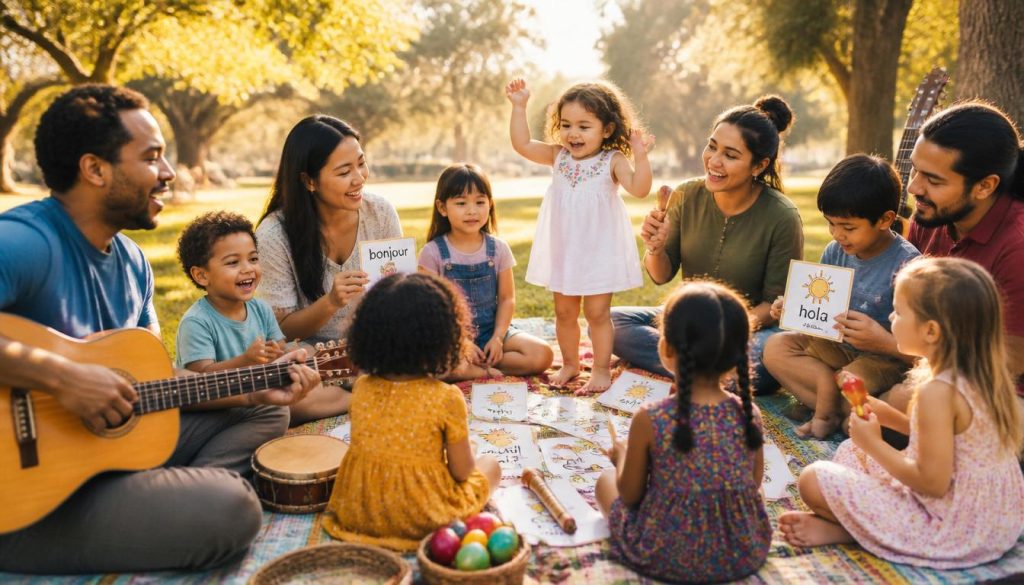
Children are born curious.
Long before they learn to read or write, they are already listening closely to the world around them. They notice different sounds, copy funny voices, and repeat words they have never heard before simply because they are fascinated by them. To a young child, a new language is not something to be afraid of. It is something to explore.
That is one of the reasons I love teaching languages through music.
When I introduce a song in French or Spanish, I rarely hear children say, “That sounds difficult.” Instead, I see smiles, giggles, and wide eyes. They are excited to discover something new. They happily repeat words that might seem challenging to an adult because, to them, it feels like a game.
Music turns language learning into an adventure.
Children Hear Possibilities, Not Obstacles
As adults, we often approach a new language with hesitation. We worry about pronunciation, making mistakes, or saying the wrong thing.
Children think differently.
They are naturally willing to experiment. They repeat sounds just because they are interesting. They laugh when they hear a new word and immediately want to try saying it themselves.
This openness is one of childhood’s greatest gifts.
Music protects that sense of curiosity because songs remove the pressure of getting everything exactly right. Instead of focusing on perfect pronunciation, children are focused on singing, moving, clapping, and having fun.
Before they even realize it, they are learning.
Songs Help New Words Find a Home
Have you ever noticed how easily children remember the words to their favorite songs?
That is because music gives language a rhythm, a melody, and an emotional connection. Those three things help the brain organize and remember information in remarkable ways.
When we sing together, children are doing so much more than repeating lyrics. They are hearing the natural rhythm of a language, practicing pronunciation, building vocabulary, and developing listening skills without feeling like they are in a lesson.
I often watch children proudly sing a phrase in French or Spanish that they learned only minutes earlier. The melody gives them confidence because it makes unfamiliar words feel familiar.
That confidence grows every time they sing.
Every Language Opens a New Window
One of my favorite moments during class is watching children realize that people around the world may speak different languages, yet they all laugh, sing, dance, and celebrate in wonderfully similar ways.
Music has a beautiful way of making the world feel both exciting and welcoming.
A simple song can introduce children to another culture without overwhelming them. They begin to understand that there are many different ways to say “hello,” count to ten, or sing about the sunshine.
Instead of seeing differences as something unusual, they begin to see them as something interesting.
That kind of perspective stays with children long after the song ends.
Learning Together Creates Lasting Memories
Language learning becomes even more meaningful when families join the experience.
One of the things I encourage parents to do is continue the songs at home. Children absolutely love teaching their families the new words they have learned.
Suddenly, the dinner table becomes a place for singing in French. The car ride becomes a chance to practice colors in Spanish. A bedtime song becomes an opportunity to explore another culture together.
These moments are about much more than vocabulary.
They become family memories.
Children remember how learning made them feel. When language is introduced through laughter, music, and connection, they develop a lifelong positive relationship with learning itself.
Music Builds Confidence to Explore the World
The goal has never been to create perfect speakers overnight.
The goal is something much bigger.
We want children to feel comfortable trying something new. We want them to discover that unfamiliar words are exciting instead of intimidating. We want them to understand that every language tells a story and every culture has something beautiful to share.
Music gives children the confidence to take that first step.
Every song they sing becomes an invitation to explore a little further.
Every rhythm reminds them that learning can be joyful.
Every new word becomes another way to connect with the people around them.
Giving Children a Bigger World
One of the greatest gifts we can give children is the understanding that the world is much bigger than their own neighborhood.
When children experience different languages through music, they begin building curiosity, empathy, and respect for people whose lives may look different from their own.
They learn that communication is not only about words. It is about listening, sharing, laughing, and celebrating together.
That is why I believe childhood should be multilingual.
Not because every child needs to become fluent in several languages.
But because every child deserves the opportunity to discover how wonderfully diverse, colorful, and connected our world really is.
At Armelle For Kids, that journey begins with a guitar, a few joyful instruments, a simple song, and the willingness to sing something new.
Sometimes, all it takes is one melody to open a child’s heart to an entirely new world.