


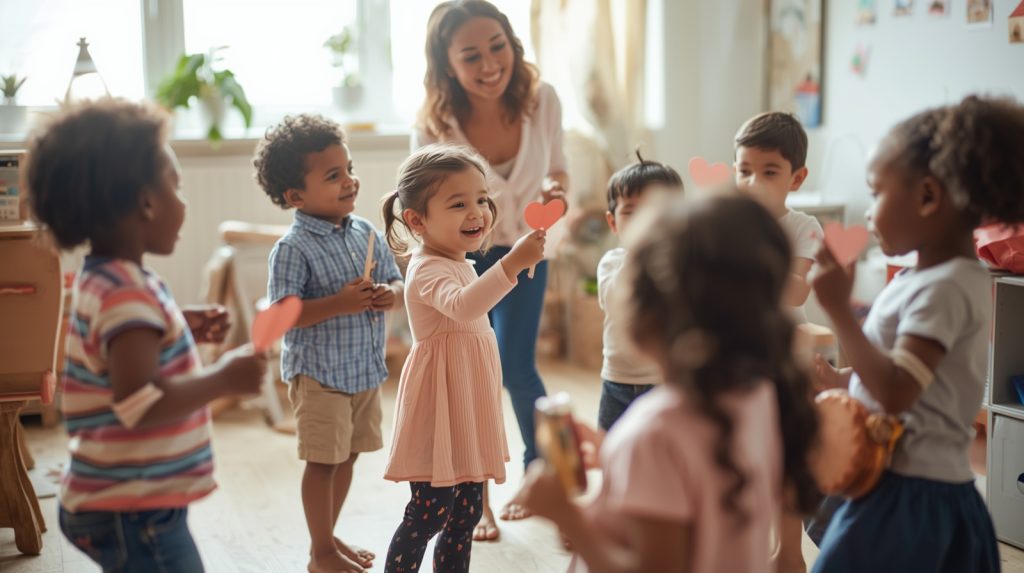
February is often wrapped in hearts, cards, and sweet treats, but for young children, love looks a little different. It looks like sharing an instrument, waiting for a turn, holding hands in a circle, or singing side by side with a friend.
We believe that one of the most powerful ways children learn kindness, friendship, and empathy is through music. Not through lectures or rules but through rhythm, repetition, and joyful connection.
Why Music Is a Natural Teacher of Kindness
Music is inherently social. When children sing or play together, they are practicing skills that sit at the heart of friendship:
-Listening to others
-Taking turns
-Matching rhythm and movement
-Sharing space and attention
-Celebrating each other’s voices
In a music circle, every child matters. There is no “best singer” or “right way” to move; just participation, presence, and play. That sense of belonging lays the foundation for kindness to grow.
How Songs Help Children Build Friendship Skills
Friendship can be tricky for little ones. Music makes it easier.
When children sing together, they learn to cooperate without pressure. A shared song gives them something to do together, even when words are still developing. For children learning a new language or feeling shy, music becomes a bridge, inviting them in without needing to explain.
Through music, children learn that:
-Everyone’s voice has value
-Working together creates something beautiful
-Joy grows when it’s shared
These are big lessons, taught through small, joyful moments.
Simple Ways to Teach Kindness Through Music
You don’t need a formal lesson or perfect pitch. Here are easy ways families and educators can use music to nurture kindness and friendship:
1. Sing together, often
Group singing builds unity. Whether it’s a hello song, a cleanup tune, or a silly made-up melody, shared singing helps children feel connected and included.
2. Encourage Musical Turn-Taking
Passing a shaker, drum, or microphone teaches patience and respect. Waiting becomes easier when there’s music involved!
3. Celebrate Every Contribution
Clap for every child. Cheer for effort, not perfection. This shows kindness and shows children how to support one another.
4. Use Songs About Feelings
Music gives children language for emotions. Songs about happiness, calm, or frustration help children recognize feelings in themselves and in others.
5. Make Music a Shared Joy, Not a Performance
When music stays playful, children feel safe to try, explore, and connect. That safety is where empathy grows.
Music Teaches Love Without Needing Words
One of the most beautiful things about music is that it doesn’t require translation. A rhythm can be shared. A melody can be felt. A smile can be mirrored.
This is especially powerful in multicultural spaces, where music helps children connect across languages and backgrounds. A song becomes a common ground, a place where everyone belongs.
Big Love Starts With Little Songs
Kindness doesn’t come from one big lesson. It’s built through many small moments. A shared song. A shared laugh. A shared beat.
This February, as we celebrate love and friendship, remember that the simplest songs can teach the biggest lessons. Because when children learn to sing together, they’re also learning how to care for one another.
And that kind of love lasts far longer than any Valentine.