


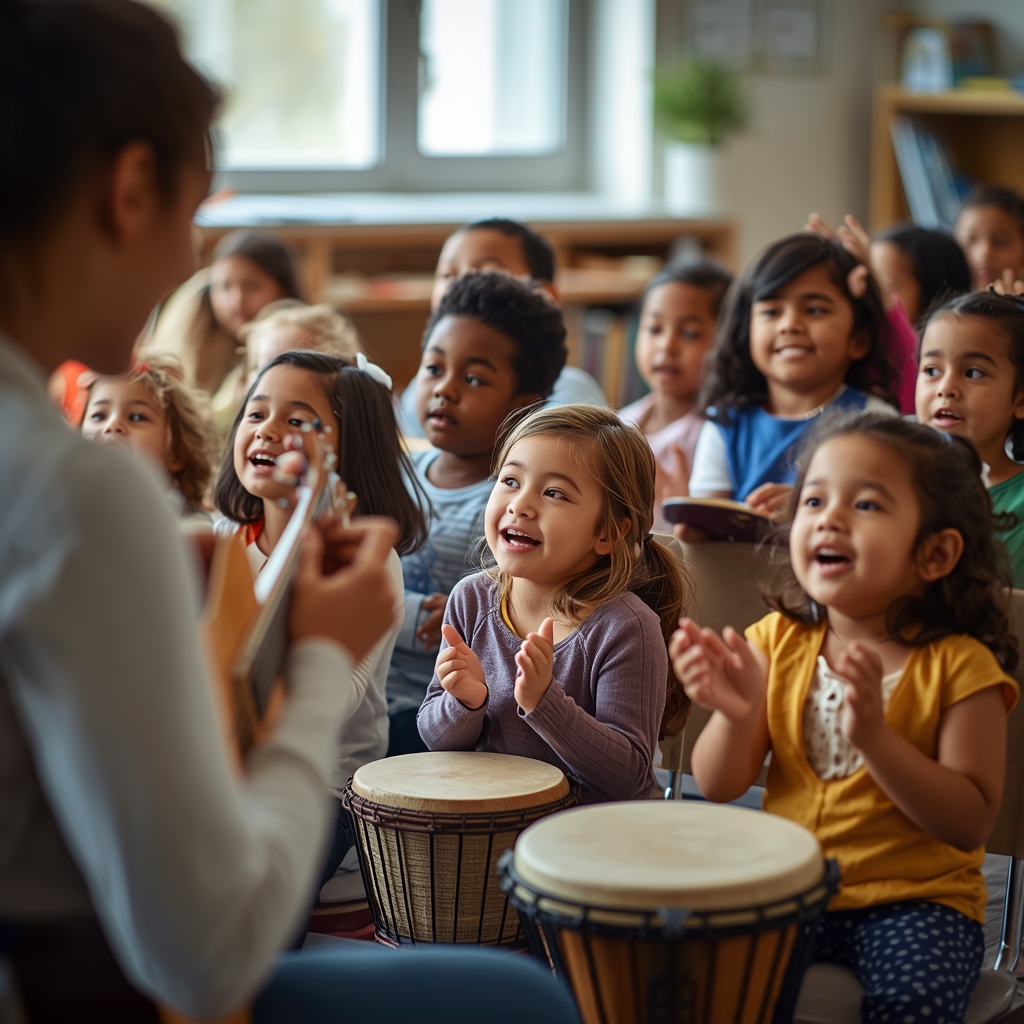
There is a moment that happens in almost every class.
A child who walked in a little unsure suddenly leans forward. Their eyes widen when they hear the first strum of the guitar or the deep vibration of the drum. Their bodies begin to move before they even realize it. Their hands start clapping. Their voice joins the group.
And just like that, something shifts.
It feels magical when you watch it happen. But it is not magic. It is science.
I see this transformation every day. When children make music, they are not just having fun. Their brains are lighting up in extraordinary ways.
Music is doing far more than filling the room with sound.
It is building connections inside their growing minds.
When Music Plays, the Brain Wakes Up
One of the most beautiful things about music is that it activates the whole brain at once. When a child listens to rhythm or sings a melody, multiple areas engage together. The parts responsible for movement, language, memory, and emotion all begin working in harmony.
Think about what happens when we sing a song in French or Spanish. A child is listening carefully to new sounds. They are coordinating their breath. They are remembering lyrics. They are matching pitch. They are often moving their bodies to the rhythm.
All of that is happening at the same time.
Unlike many traditional learning activities that isolate one skill, music integrates them. It strengthens neural pathways by asking the brain to multitask in a joyful and meaningful way. That kind of whole-brain engagement supports reading readiness, language development, coordination, and cognitive flexibility.
And the child simply feels like they are singing.
Rhythm Builds Focus Without Forcing It
Children are naturally energetic, especially in the spring. They want to move, to explore, to wiggle. Instead of fighting that energy, rhythm gives it structure.
When we use my hand drums or pass around small percussion instruments, children learn to listen for cues. They wait for their turn. They follow patterns. They stop when the music stops and start again together.
What looks like a simple rhythm game is actually building executive function skills. These are the skills that help children focus, manage impulses, and remember instructions. They are the foundation for success in school and in life.
The difference is that in music, these skills grow organically. Children are motivated because they are engaged. They are not practicing self-control because they are told to. They are practicing to stay in the rhythm.
Music turns discipline into participation.
Melody Makes Language Come Alive
As someone who teaches language through music, this is the part that never stops amazing me.
Children can struggle to repeat new vocabulary when it is presented as plain speech. But wrap those same words in melody, and suddenly they stick. The rhythm supports pronunciation. The repetition feels natural. The tone invites confidence.
I have watched children who barely speak in class sing entire phrases in another language with clarity and pride. Music lowers the pressure and raises the courage.
There is research behind this. Melody activates memory centers in the brain. Patterns make information easier to retrieve. But there is also something deeply human happening.
When a child sings in another language, they are not just learning words. They are stepping into a new culture. They are expanding their sense of the world. They are discovering that their voice can carry more than one sound.
That discovery builds confidence that extends far beyond the song.
Music Teaches Emotional Intelligence
Music also gives children something harder to measure but just as important.
It gives them a safe space to feel.
In one class, a fast upbeat song might fill the room with jumping and laughter. In the next moment, a softer melody can calm the energy and slow the breathing. Children begin to notice how different sounds make them feel. They learn to name those feelings.
When we explore loud and soft, fast and slow, strong and gentle, children begin to understand emotional contrast. They recognize excitement. They recognize calm. They begin to see those states in themselves and in others.
Making music together also teaches empathy. Children learn to listen to one another. They adjust their volume. They harmonize. They experience the beauty of creating something collectively.
Those moments build social awareness in a way no worksheet ever could.
Joy Is a Powerful Teacher
There is one more piece that cannot be ignored.
Joy changes the brain.
When children feel joy, their brains release dopamine. Dopamine supports motivation, attention, and memory. It makes learning stick. It builds positive associations with growth and discovery.
When a child associates language learning or rhythm practice with happiness, they are more likely to engage again. Joy becomes a bridge to confidence.
This is why I bring real instruments into the room. Children feel the drum’s vibration in their hands. They hear the live resonance of the guitar. The experience is physical and alive. It is not background noise. It is participation.
That embodied experience strengthens both memory and meaning.
Music Is Not Extra
Sometimes music is described as enrichment, as if it sits outside of real development. But everything we know about brain science tells a different story.
Music strengthens cognitive skills.
It accelerates language acquisition.
It supports emotional regulation.
It builds social connections.
It nurtures confidence.
And it does all of this while childrenare laughing.
That is the science of joy.
At Armelle For Kids, we believe children learn best when their minds and hearts are both engaged. Music makes that possible. Every rhythm builds a pathway. Every melody strengthens a connection. Every shared song plants a seed for growth.
And when children leave class still humming, that is not just a tune stuck in their heads.
It is learning that has taken root.